Why Your Poolside Outfit Stops Working After the First Swim

Quick Answer: Poolside outfits fail after the first swim because wet fabric behaves like a different fabric — it clings, goes semi-sheer, stretches around 5 to 10 percent, and stops draping. Chlorine also strips oils and dulls colour on contact, and the sun angle that flattered you at noon is unrecognisable by four. The fix is choosing pieces that are tested wet, not dry, and building the outfit so the dry layer never touches the pool.
Everything worked at eleven in the morning.
By two, the cover-up is stuck to your back, the linen has gone limp and the whole thing looks like an accident.
Nothing was wrong with the outfit. It was only ever tested dry.

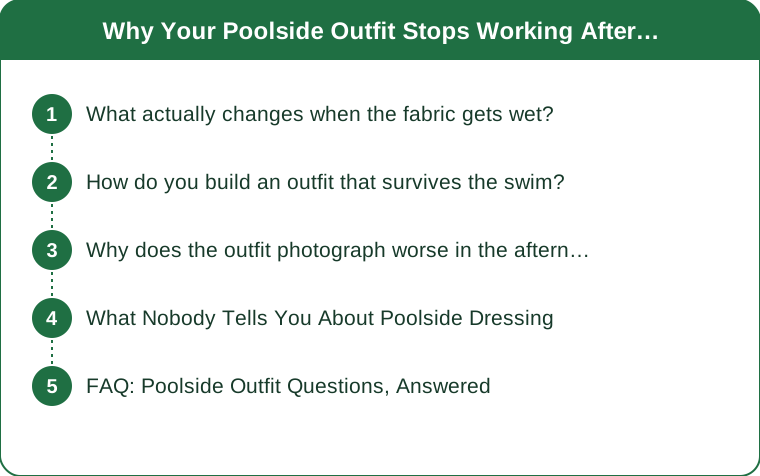
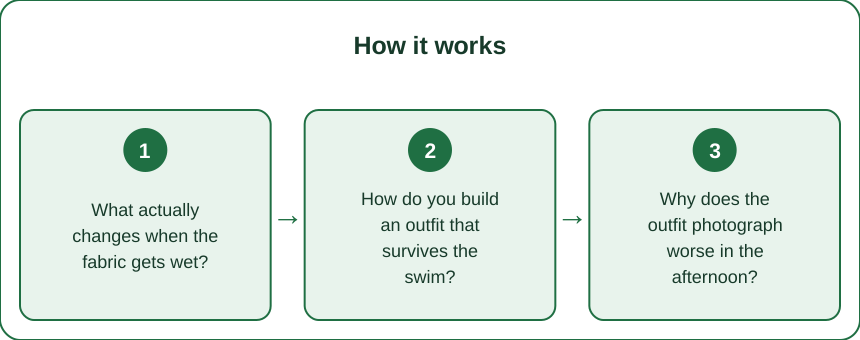
What actually changes when the fabric gets wet?
Five separate changes, and they arrive in a predictable order.
Opacity drops immediately. Water fills the air gaps between fibres and eliminates the light scattering that creates opacity. Pale colours lose the most because they depend on scattering rather than absorption.
The fabric stretches. Most knits elongate 5 to 10 percent wet, which is why a cover-up that skimmed at eleven hangs low and shapeless at two.
Drape reverses. Wet fabric is heavier and stiffer at the same time. Fluid pieces go limp; structured pieces go rigid.
It clings rather than skims. Surface tension holds damp fabric against skin, which changes the silhouette more than any styling decision you made that morning.
Colour deepens unevenly. Wet patches read several shades darker, and the boundary between wet and dry is the least flattering thing in any pool photograph.
And chlorine works on contact, not over time. It begins degrading elastane and dulling dye from the first swim, which is why season-old swimwear sags at the leg openings first.
How do you build an outfit that survives the swim?
The principle is separation: the pieces that get wet and the pieces that stay dry should be different pieces.
Choose a cover-up you are happy to soak. If it cannot get wet, it is not a pool cover-up, it is a lunch outfit that happens to be at a pool.
Prefer textured weaves over smooth flat ones. Seersucker, gauze, waffle and crinkle cotton hide dampness because the surface is already irregular. Smooth poplin shows every wet patch.
Go deeper on colour than feels necessary. Deep tones rely on dye absorption, which water does not undo. Pale pastels are the pieces that betray you wet.
Keep one genuinely dry layer in the bag. A separate dry shirt or kaftan for after is worth more than any single upgrade to what you arrived in.
Avoid anything that needs pressing. Linen and cotton poplin crease permanently once damp and sat on. Crinkle and jersey do not.
Watch the metal. Chlorine and salt tarnish plated jewellery and corrode cheap hardware. Leave the good pieces in the bag.

Why does the outfit photograph worse in the afternoon?
This one is lighting, and it is almost entirely predictable.
Midday light is overhead and even. It flattens texture and washes out the wet-versus-dry contrast that develops later.
Afternoon light is low and directional. It rakes across fabric, revealing every crease, damp patch and cling line that midday hid.
Water reflection adds uplight. Late afternoon sun bouncing off the pool throws light upward, which is unflattering in a way no one anticipates and is strongest between three and five.
Colours shift warm. Late light adds a yellow-orange cast that turns cool pastels muddy. Warm tones — terracotta, olive, cream — hold up far better.
Skin looks shinier. Sunscreen plus sweat plus low-angle light is a specular combination. This is a lighting fact, not a grooming failure.
Seasonal note: by mid-August the sun sits noticeably lower earlier in the day, so the difficult afternoon light window starts around three rather than four. Outdoor pool photos are worth taking earlier than they were in June.
What Nobody Tells You About Poolside Dressing
The best cover-up is slightly too big. Wet fabric clings, so a piece that skims dry will grip wet. Half a size up disappears the problem.
White is the hardest colour at a pool, not the easiest. It is the classic image and the least forgiving reality — sheer wet, and it yellows from sunscreen.
Sunscreen destroys fabric. Avobenzone and other UV filters permanently stain white and light fabrics, and no wash reliably removes it. This ruins more poolside clothing than chlorine does.
Rinsing matters more than washing. A freshwater rinse immediately after swimming removes most of the chlorine before it can work on the elastane. Doing it at the pool, not at home, is what preserves swimwear.
Two swimsuits outlast four. Elastane needs a full 24 hours to recover its shape. Alternating pieces roughly doubles their usable life.
And the thing nobody says out loud: almost every poolside photograph you admire was taken in the first thirty minutes, before anyone got in the water.
FAQ: Poolside Outfit Questions, Answered
How do I know if a cover-up will go sheer?
Hold it over your hand toward the brightest light. If you can read your fingers dry, it will be genuinely transparent wet.
Is linen a good poolside fabric?
It looks superb dry and creases permanently once damp and sat on. Cotton gauze gives the same look and survives the day.
Does chlorine really ruin swimwear that fast?
Elastane degradation begins on contact. Suits worn several times a week without rinsing commonly lose shape within a single season.
What colour cover-up is most forgiving?
A mid-to-deep tone in a textured weave. Deep green, navy, terracotta and black all handle wet patches invisibly.
Can I get sunscreen stains out?
Rarely, once set. Pre-treating with dish soap before washing helps if you catch it the same day.
Should I change out of a wet swimsuit poolside?
For comfort and for the garment, yes. Sitting in a wet suit is the fastest route to both chafing and a stretched seat.
TL;DR:
- Wet fabric goes sheer, stretches 5 to 10 percent, clings and loses drape — all within minutes of the first swim.
- Choose textured weaves and deeper colours; they hide dampness where smooth pastels expose it.
- Keep a completely dry layer in the bag rather than expecting one outfit to do both jobs.
- Sunscreen stains permanently and ruins more poolside clothing than chlorine.
- Rinse swimwear at the pool and alternate two suits to double their life.
Before the next pool day, run the hand test on your cover-up. Ten seconds now saves the whole afternoon.
Keep Reading
This article is for general informational and styling purposes only. Fit, sizing, and product availability may vary.