Why Do Poolside Pieces Earn Their Place After the Season Ends?

Quick Answer: Most poolside pieces are loose, lightweight, and unstructured — which makes them poor standalone autumn garments and excellent layering pieces. A kaftan over a fitted knit, a wrap skirt over opaque tights, or an oversized shirt as a light jacket all work because the piece is providing shape and interest while something else provides warmth. The mistake is trying to wear them the way you wore them in July.
Everything goes into the loft in October.
About a third of it should not.
This is general information, not medical advice.


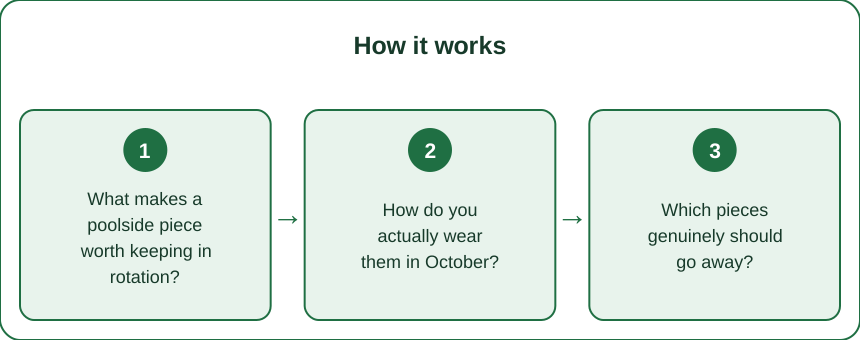
What makes a poolside piece worth keeping in rotation?
Three properties, and the pieces that have all three are the ones worth pulling out again.
Volume without structure. Kaftans, oversized shirts, and loose wraps have shape but no built-in structure. That is a weakness alone in cold weather and a strength over something fitted — the volume reads as deliberate layering rather than as a summer garment worn out of season.
Fabric that behaves as a mid or outer layer. Linen, heavier cotton, and substantial viscose all work over knitwear. Very sheer chiffon, cheap thin jersey, and anything with obvious beach detailing generally do not — they read as what they are.
A shape that is not swim-specific. A wrap skirt is a skirt. A camp-collar shirt is a shirt. Anything with an obviously beach-specific detail — a built-in bra, a tie designed to be worn over a bikini, prominent resort branding — is much harder to move into an autumn wardrobe.
The pieces that fail this test are the ones designed exclusively for one context. The pieces that pass were always just clothes that happened to be bought for a holiday.
How do I decide quickly?
Hold it up against a jumper. If the combination looks like an outfit rather than like a summer item worn over the wrong thing, keep it out.
How do you actually wear them in October?
The principle is the same in every case: the summer piece provides shape, and something underneath provides warmth.
Kaftan or tunic over a fitted knit. A fine-gauge roll neck or a long-sleeve fitted top underneath, with the kaftan providing the volume on top. Add trousers or jeans rather than the shorts it was worn with. This works particularly well with anything in a solid colour or a subtle print — busier resort prints are harder.
Wrap skirt with opaque tights and boots. A wrap skirt is one of the most transferable items there is. Opaque tights change the entire register of a summer skirt, and boots rather than sandals complete the shift. A knit tucked in, and a belt at the natural waist, and it is an autumn outfit.
Oversized shirt as a light layer. A linen or cotton camp-collar shirt worn open over a tee and under a coat is genuinely useful through autumn. It is the same job a light overshirt does, and you already own it.
Wide-leg trousers with knitwear. Lightweight summer trousers in cotton or linen work well into autumn with a heavier top half, particularly with boots. Colour is what usually dates them — cream and stone work all year; bright resort colours are harder.
Sarong as a scarf. A large lightweight rectangle is a scarf. It is not the warmest scarf you own and it is a genuine autumn accessory in a way it does not look like on the shelf.
What about colour clashing with an autumn wardrobe?
Summer pieces are often lighter and brighter than autumn ones, and that is usually an asset rather than a problem — a pale layer against darker autumn colours reads deliberate. What is difficult is a piece in a distinctly summer print, which tends to fight everything around it.

Which pieces genuinely should go away?
Being honest about this saves storage space and decision fatigue.
Anything with a built-in bra or bikini top. These are swim-adjacent and read that way regardless of what you put underneath.
Very sheer fabrics with no body. A chiffon cover-up over a jumper looks like exactly what it is. Sheerness works when it is deliberate and structured; a beach cover-up rarely is.
Terry towelling in anything other than a robe. Towelling shorts and dresses had a moment in summer. In October they read as leaving a pool.
Anything with sand permanently in the seams. Practical rather than stylistic, and it is worth checking.
Bright saturated resort colours in prints. Solid bright colours often transfer fine. A print combining several summer-specific colours is much harder to place, and it will look wrong next to autumn tones no matter what you do with it.
Flip-flops and pool slides. No amount of styling fixes the temperature problem.
And a note on storage: anything going away should be washed first. Sunscreen, chlorine, and salt residue all cause fabric degradation and staining over months in storage, and marks that were invisible in September become permanent yellow patches by May. This is the single most common way summer clothes are lost, and it is entirely preventable.
Should I store them somewhere specific?
Somewhere dry, dark, and temperature-stable. Lofts swing between extremes and are less kind to fabric than a wardrobe or under-bed storage.
What nobody tells you about transitional dressing
The best transitional pieces were never seasonal. A well-made linen shirt, a plain wrap skirt, wide cotton trousers — these were bought for a holiday and are simply clothes. The pieces that transfer are the ones that were never really about the pool.
Buying with two seasons in mind changes what you buy. Once you notice which summer pieces you still wear in October, next summer’s purchases shift toward solid colours, better fabric, and shapes that layer. It is a quiet improvement in how much of your wardrobe actually gets used.
Layering a summer piece over knitwear needs the knit to be fine. A chunky jumper under a kaftan creates bulk and the volume reads as accidental. Fine gauge underneath, volume on top, is the combination that works.
Tights change more than any other single item. Opaque tights move a garment across seasons more decisively than any styling choice. They are also the cheapest way to test whether a summer piece has autumn potential.
The transitional window is short and worth using. Late September and October are the weeks when lightweight layers genuinely work. By late November most of these pieces do go away, and the few weeks of use are still worth having.
Anything you have not worn in two summers is unlikely to have an autumn life. The pieces worth transitioning are usually the ones you already reach for.
FAQ: Poolside to Autumn Questions, Answered
Is it obvious when someone is wearing summer clothes in autumn?
What reads as out of season is usually bare legs, sandals, or a garment worn as a standalone that clearly needs warmth. The same piece layered over autumn basics rarely reads as summer at all.
What is the easiest piece to transition?
A wrap skirt or an oversized shirt. Both are ordinary garment shapes and both accept layering without any adjustment.
Should I wash things before storing them even if they look clean?
Yes. Sunscreen and body oils are invisible when fresh and oxidize to yellow marks over months. This is the most common cause of summer clothes being ruined in storage.
Can I wear linen in autumn?
Linen is a moderate-weight fabric that works well as a layer well into autumn. It is more versatile than its summer reputation suggests, particularly in heavier weaves.
What about summer dresses?
Over a fine roll neck, with opaque tights and boots, many summer dresses work through autumn. Sleeveless and midi-length transfer most easily.
How long does the transitional window last?
In most temperate regions, roughly from the last warm week of September through to the first properly cold spell — often six to eight weeks. It is short, and it covers a decent share of the season.
TL;DR:
- Poolside pieces work in autumn when they provide shape and something underneath provides warmth.
- Kaftans over fine knits, wrap skirts with opaque tights, and oversized shirts as light layers all transfer directly.
- Built-in bras, sheer fabrics, towelling, and busy resort prints do not — let those go away.
- Opaque tights move a garment across seasons more decisively than any other single item.
- Wash everything before storing; sunscreen residue oxidizes into permanent yellow marks over winter.
About a third of what you put away in October did not need to go. The trick is that it works over things now instead of on its own.
This is general information, not medical advice.
Keep Reading
This article is for general informational and styling purposes only. Fit, sizing, and product availability may vary.