Why Your Poolside Outfit Falls Apart the Second You Step Into Air Conditioning

Quick Answer: Evaporative cooling accelerates in dry, moving indoor air, so a damp outfit that felt pleasant outdoors becomes genuinely cold within a minute or two of stepping inside. The fix is a dedicated dry layer you carry rather than wear, plus fabrics that release water fast so the transition period is short. A damp cotton cover-up is the single worst item for this and the most common one.
Outside you are perfectly comfortable. Ten steps into the lobby you have goosebumps and your damp shorts feel like a cold compress. The outfit did not fail. It met a completely different set of physics.

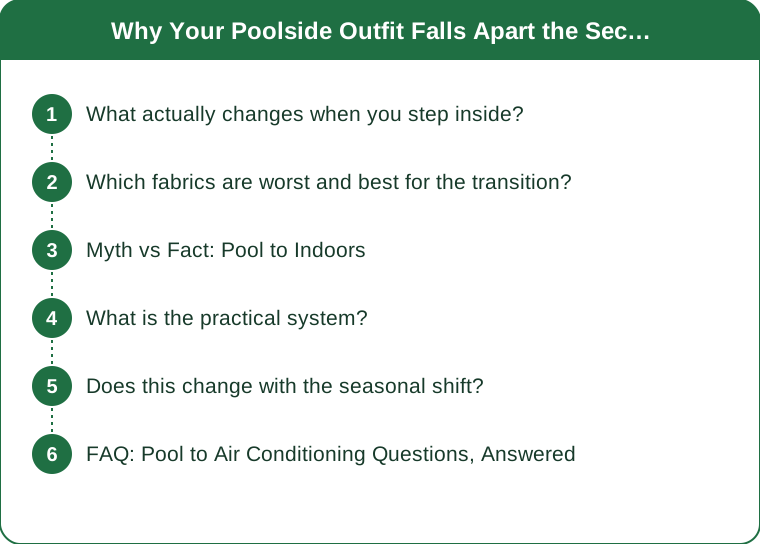
What actually changes when you step inside?
Three variables flip at once, and they compound.
Air temperature drops by 20 degrees or more, so the difference between your skin and the air widens dramatically.
Humidity drops. Air conditioning removes moisture, which means indoor air has far more capacity to absorb water from your damp clothing. Evaporation speeds up.
Air movement increases. Vents push air across you continuously, which strips the thin layer of warm, humid air that had been sitting against your skin outdoors.
Evaporation is a cooling process; water absorbs a substantial amount of energy changing to vapor, and that energy comes from your body. Outdoors in warm, humid, still air, evaporation is slow and the cooling is welcome. Indoors it is fast and the cooling is excessive.
So the same damp garment goes from a comfort feature to a heat sink strapped to your torso, and the wetter and more absorbent the fabric, the more energy it pulls out of you.
Which fabrics are worst and best for the transition?
The ranking is almost the inverse of the poolside comfort ranking, which is why this catches people out.
Worst: cotton and cotton-blend terry. High absorbency, slow drying, and it holds water directly against skin. A damp cotton cover-up will stay damp for an hour indoors and cool you the entire time.
Bad: linen when genuinely wet. Excellent dry, but it absorbs a lot and holds it.
Better: rayon and viscose blends. They dry faster than cotton and drape away from the body, which reduces contact area.
Best: technical synthetics and lightweight nylon. They hold very little water, release it quickly, and the transition period is short.
Also good: anything you can take off. This is the real answer and it gets skipped in favor of finding a magic fabric.
A useful mental model: for the walk indoors, you want either something that is already dry or something that will be dry in three minutes. Anything in between is the problem, and a mid-weight damp garment is the worst case because it holds enough water to cool you and not so little that it dries quickly.
Myth vs Fact: Pool to Indoors
Myth: A bigger, thicker cover-up keeps you warmer indoors. Fact: If it is damp, thicker is colder, because there is more water to evaporate and more contact with skin. Thickness only helps when it is dry.
Myth: You feel cold indoors because the AC is too high. Fact: A dry person in the same room is usually comfortable. The temperature is a contributor; the water in your clothing is the cause.
Myth: Sitting still helps you warm up. Fact: Slightly, but staying in the airflow path matters more than movement. Moving away from a vent does more than anything else you can do in the first minute.
Myth: The swimsuit itself is the problem. Fact: Swimsuit fabrics are among the fastest-drying things you own. The cover-up, the shorts, and the hair are holding most of the water.
The one people find most useful: your hair holds an enormous amount of water and sits against your neck, which is a high-heat-loss area. Wringing hair out and putting it up before you go inside changes the experience more than any garment swap, and it costs nothing.

What is the practical system?
Carry a dry set, and treat the poolside outfit as disposable to the transition.
One genuinely dry layer in the bag. Not a beach towel. A light long-sleeve in a quick-dry fabric or a lightweight knit that lives in the bag and only comes out indoors. It stays dry because it never goes near the pool.
A microfiber towel rather than a terry one. Absorbs more per gram, dries fast, and takes almost no space, which means you actually carry it.
Change the bottom half, not just the top. Damp shorts or a damp suit under a dry top still cools you through the hips and thighs. If you are going indoors for more than a few minutes, this matters more than the top layer.
Dry shoes. Wet feet in air conditioning are an underrated source of feeling cold, and sandals that hold water between the foot and the footbed keep them wet for a long time.
Do the hair thing. Wring, wrap, or tie up before the doors.
That is a five-item system, four of which fit in a small bag, and it turns the walk to dinner from an ordeal into a non-event.
Does this change with the seasonal shift?
Yes, and late summer is when it gets worse rather than better.
As outdoor temperatures ease from peak summer, the gap between air-conditioned indoor spaces and outdoor air narrows slightly, which sounds helpful. But two things work against you.
Outdoor humidity in late summer often stays high while temperatures drop, so you are damper for longer outdoors and the evaporative shock indoors is unchanged.
And sunset arrives noticeably earlier. The late-afternoon window when you would previously have dried off in strong sun before heading in is shorter and weaker, so more people go indoors genuinely wet.
The practical adjustment: from late August, add an actual layer with sleeves to the bag rather than relying on a light cover-up, and plan the last swim earlier if you have somewhere to be. The sun that used to dry you in fifteen minutes at 5pm now takes considerably longer, and by 6:30 it is not doing the job at all.

FAQ: Pool to Air Conditioning Questions, Answered
Why do I feel colder indoors than I did in the pool?
Water conducts heat away efficiently, but pool water is often not far below skin temperature and your body adjusts. Evaporation off wet skin in moving dry air removes heat faster than the pool did, which is genuinely why the deck and the lobby feel colder than the water.
Is there a fabric that works both wet and dry?
Lightweight nylon comes closest. It holds little water, dries quickly, blocks a bit of airflow, and packs small. It is not the most beautiful option, which is why people keep trying to make cotton work.
What about the drive home in a cold car?
Same problem with the added factor of a vent aimed at you and a seat that holds moisture. Sit on a towel, redirect the vents, and change the bottom half before you get in. That is the single most common version of this complaint.
TL;DR:
- Indoor air is colder, drier, and moving, which accelerates evaporation and pulls heat out of you fast
- Damp cotton is the worst offender; technical synthetics and lightweight nylon transition best
- Carry one genuinely dry layer that never goes near the pool, change the bottom half, and dry your feet
- Wring and tie up your hair before you go inside; it holds more water than any garment
Stop looking for a cover-up that works in both places. Carry a dry layer that only comes out indoors, and the problem disappears.
Keep Reading
This article is for general informational and styling purposes only. Fit, sizing, and product availability may vary.