Why Your Cover-Up Looks Better Wet Than Dry - and How to Pick One That Does Both

Quick Answer: Wet fabric is heavier, so it drapes - it falls into vertical lines instead of standing away from the body. As it dries it loses that weight and reverts to whatever shape the fibre naturally holds, which for most cheap cover-ups is a stiff, shapeless one. The fix is to buy for dry drape rather than wet drape: heavier weight, higher natural-fibre content, and a cut that has structure without needing water to find it. If it only looks good soaked, you own a cover-up that works for about twelve minutes.
This is one of those style problems with a straightforward physical explanation.
And it changes what you should be feeling for on the rack.

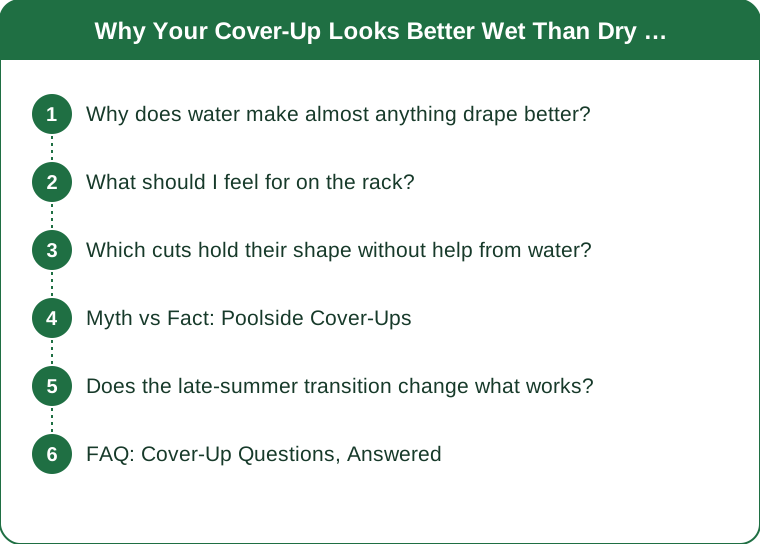
Why does water make almost anything drape better?
Weight, surface tension, and the loss of fibre spring.
Drape is a function of weight versus stiffness. A fabric falls into soft folds when its weight overcomes its resistance to bending. Water adds significant weight without adding stiffness, which pushes almost any fabric toward the drapey end of the spectrum.
Wet fibres also lose their spring. Cotton and rayon absorb water into the fibre itself, which softens the internal structure and makes the fabric temporarily more pliable. This is the same reason a wet cotton shirt clings and a dry one stands away.
Then surface tension does the styling for you. Wet fabric sticks lightly to itself and to skin, so it stays where you put it. Every fold you make when you throw it on holds instead of springing open.
As it dries, all three effects reverse at once. The weight leaves, the spring returns, the folds release. What you are left with is the fabric’s actual character - and if that character is a lightweight polyester with a stiff hand, it looks like a tent.
The useful reframe: wet drape is a preview of a much heavier fabric. If you love how something looks wet, what you actually want is a version of it in a heavier weight.
What should I feel for on the rack?
Three tests, none of which take longer than fifteen seconds.
The scrunch test. Grab a fistful and squeeze, then let go. A good cover-up fabric falls open smoothly and holds only soft creases; a poor one springs back stiff or holds sharp wrinkles. Sharp wrinkles mean linen that will need managing - which is fine if you like the look. Springing back stiff means synthetic that will never drape dry.
The hang test. Hold it by the shoulders at arm’s length and look at the hem. A fabric with good dry drape falls into visible vertical folds under its own weight. One with poor drape flares out into a triangle. The triangle is what you will look like at four in the afternoon.
The weight test. Pick it up and notice how substantial it feels. Very lightweight cover-ups rely on water to look intentional. A slightly heavier weight - the kind that feels like it has some presence in your hand - keeps its shape all day.
And one shortcut that works surprisingly well: check the fibre content label. Cotton gauze, linen, linen blends, viscose, and cupro all drape dry. Thin polyester and most crinkle nylon do not, no matter how good they look on the hanger.
A note on gauze specifically: double gauze is the sweet spot for poolside. It is light enough to be comfortable in heat and has enough weight and texture to fall properly when dry.
Which cuts hold their shape without help from water?
Cuts with an intentional line rather than a rectangle.
Anything with a defined shoulder. A dropped shoulder or a set sleeve gives the fabric a starting point to fall from. A pure rectangle - the classic square kaftan - relies entirely on fabric weight, which is why the cheap ones look shapeless dry.
A waist reference of any kind. A tie, a drawstring, a subtle gather. You are giving the fabric one place to break, and it will do the rest. This is the reason a belted robe-style cover-up nearly always reads better than an unbelted one.
Length below the widest point of your hip. A cover-up that stops right at the hip has to sit over the widest part of the shape, which pushes the hem out. A few inches longer and the fabric falls past that point and hangs vertically.
Slits and open fronts help more than they look like they should. A vertical opening gives the eye a line and lets the fabric hang in two panels rather than one wide plane. Two narrow panels drape better than one wide one at the same fabric weight.
What to avoid: a stiff lightweight fabric in a full, gathered cut. All that volume needs weight to fall. Without it, you get a lampshade - and it will look perfect for the eleven minutes it is wet.

Myth vs Fact: Poolside Cover-Ups
Myth: Lighter fabric is always better in heat. Fact: Weave openness matters more than weight. An open-weave linen or gauze at a moderate weight breathes better than a thin, tightly woven synthetic. The synthetic feels light and traps air against your skin.
Myth: Linen wrinkles too much for a cover-up. Fact: A cover-up is the single best use for linen precisely because the wrinkles read as intentional there. This is the one context where linen’s main drawback is a feature.
Myth: You should buy a cover-up in the same size as your clothes. Fact: Cover-ups are drape garments and often work better slightly oversized - more fabric weight, more fall. The exception is anything with a defined shoulder, which needs to fit at the shoulder.
Myth: White is the safe choice. Fact: White cover-ups go translucent when wet, which is fine if intended and a surprise if not. Hold it up to the light in the store. Ivory, sand, and pale stripe patterns are far more forgiving.
Myth: The cover-up is the least important piece. Fact: It is the piece you are actually wearing for most of the day. You swim for twenty minutes and wear the cover-up for four hours.
Does the late-summer transition change what works?
Considerably - and this is the moment the difference shows.
Late-August air is warm but the water and the evenings are not. A cover-up that was purely decorative in July now has an actual thermal job to do. The lightweight rectangle that dried in ninety seconds is exactly the wrong tool when the sun drops behind the buildings at seven.
Look for something with a bit more body now. A heavier gauze, a linen blend, or a light knit. You want a piece that keeps you comfortable through the temperature drop, not one that only works at peak afternoon heat.
Sleeves start earning their place. A three-quarter or full sleeve is unnecessary in mid-summer and genuinely useful in September. It also solves the shoulder-sunburn problem, which peaks late in the season when people stop reapplying.
And the transition trick worth knowing: the right cover-up leaves the pool with you. A linen or gauze piece with a defined shoulder and a waist tie reads as a dress once you add sandals. A lightweight crinkle rectangle never does - it announces itself as swimwear-adjacent from across the room.
Practical version for this month: one heavier gauze or linen piece with sleeves and a waist reference will outperform three lightweight ones, and it stays useful through the first cool weeks of fall.
FAQ: Cover-Up Questions, Answered
How do I stop a cover-up going see-through when wet?
Fibre content and weave density. Double gauze, linen at a mid weight, and anything with a pattern all resist this well. A single-layer thin cotton in white will always go sheer - hold it against your hand under store lighting to check before buying.
Is a heavier cover-up too hot for real summer heat?
Not if the weave is open. Heat comfort comes from air moving through the fabric, not from the fabric being thin. Loosely woven linen at a moderate weight is cooler than thin tightly woven polyester.
How should I wash it to keep the drape?
Cool wash, and skip the fabric softener - it coats the fibres and dulls the way they fall. Line dry rather than tumble dry. Heat is what turns a beautifully draping cotton gauze stiff after a season.
TL;DR:
- Water adds weight without stiffness, which is why everything drapes better wet.
- Buy for dry drape: the hang test at arm’s length tells you in five seconds.
- Cotton gauze, linen, viscose and cupro fall properly dry; thin polyester never will.
- Give the fabric a reference point - a shoulder, a waist tie, a vertical opening.
- For late summer, choose more body and a sleeve so the piece survives the evening drop.
Next time you shop, hold it by the shoulders and look at the hem. If it flares into a triangle, put it back.
Keep Reading
This article is for general informational and styling purposes only. Fit, sizing, and product availability may vary.