Why Sunscreen Ruins More Poolside Outfits Than Chlorine Does

Quick Answer: Sunscreen damages poolside clothing three different ways: its oils leave greasy shadow marks that oxidize yellow over time, the common UV filter avobenzone reacts with iron in hard water to create orange, rust-like stains that appear after washing, and mineral formulas leave white streaks on dark fabric that behave like paint. Chlorine gets the blame because the damage shows up on pool-day clothes, but the pool water is mostly innocent. The fix is order of operations — apply, absorb, then dress — plus treating stains before they ever meet heat.
Once you know which of the three stains you are looking at, each one has a specific, usually successful, removal route.

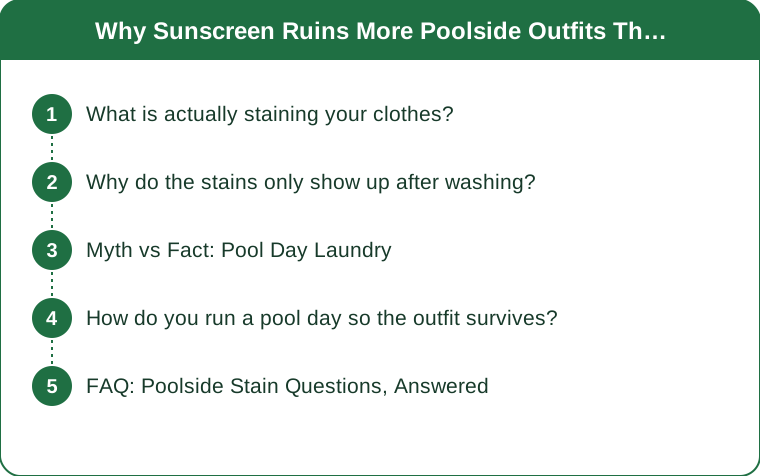
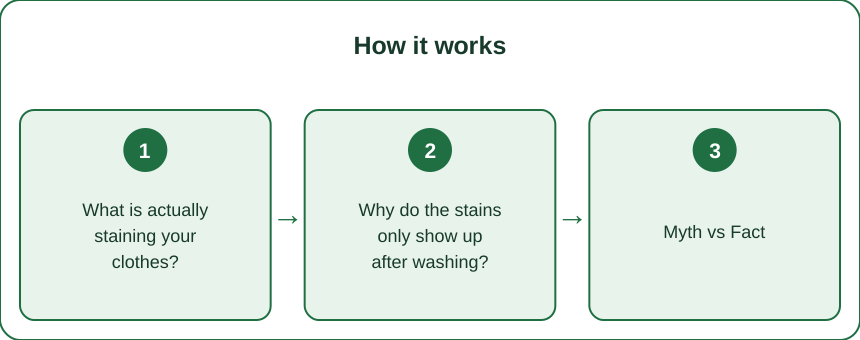
What is actually staining your clothes?
Three different substances, with three different behaviors.
The grease shadow. Most sunscreens are oil-based emulsions, and oil transfers to fabric on contact — waistbands, straps, the underarm of a cover-up, anywhere fabric presses against freshly applied skin. Fresh, it is a faint dark patch. Left through a warm wash and a dryer cycle, the oil oxidizes and sets into a yellowish shadow that ordinary detergent no longer moves.
The orange bloom. Avobenzone, one of the most common chemical UV filters, reacts with iron. Hard water carries iron; so do some pipes and some detergents. The reaction product is orange-brown and looks exactly like rust, which is why people blame the pool fence or the washing machine. It is the sunscreen plus the water, and it often does not appear until after laundering — the shirt went into the machine looking fine and came out stained.
The white paint streak. Mineral sunscreens carry zinc oxide or titanium dioxide, which are literally pigments — the same whites used in paint. On dark swim fabric, a smear of mineral SPF is a coating sitting on the fibers, and it clings stubbornly to synthetics.
Chlorine, for its part, can fade swim fabric over a season of heavy use, but it evaporates and rinses cleanly out of a cover-up. It does not leave localized stains. If the mark has a shape — a handprint, a strap line, a smear — it is sunscreen.
Why do the stains only show up after washing?
Because the wash supplies the missing ingredients: iron, heat, and time.
At the pool, the sunscreen on your cover-up is invisible or nearly so — a slightly darker damp-looking patch at most. Three things then happen in the laundry.
The iron arrives. Avobenzone needs iron to make the orange compound, and for most households the iron shows up in the wash water. This is why the same sunscreen stains clothes at one house and not at another — hard-water regions see dramatically more of it.
The heat sets the oil. A warm wash softens the oil and spreads it slightly; the dryer then bakes it into the fibers and oxidizes it toward yellow. A stain that was fully removable at 2pm becomes permanent by the time the dryer buzzes.
The invisible becomes visible. Both reactions take hours. You fold the laundry, and days later the orange patch seems to have appeared from nowhere, on a garment you are sure was clean. That delay is why sunscreen almost never gets correctly blamed.
The practical rule that falls out of this: pool-day clothes get a cold rinse the same evening, and nothing goes into the dryer until you have looked it over in good light. The dryer is the point of no return. Everything before it is recoverable; very little after it is.

Myth vs Fact: Pool Day Laundry
Myth: Chlorine bleached my cover-up. Fact: Chlorine at pool concentrations fades swimwear slowly and evenly over a season. A localized pale patch or yellow mark on a cover-up is almost always sunscreen oil or a mineral-SPF smear, set by heat.
Myth: More detergent will get the grease out. Fact: Extra detergent mostly makes extra residue. Oil needs a degreaser — a drop of dish soap worked into the spot before washing outperforms doubling the detergent every time.
Myth: White clothes are the safe poolside choice. Fact: White hides the mineral-SPF streaks but shows the avobenzone-iron orange worst of all. Dark colors do the reverse. Mid-tones and busy prints are the genuinely safe choices, because they camouflage both failure modes.
Myth: Once a sunscreen stain is there, it is permanent. Fact: Fresh grease lifts with dish soap; the orange iron stain responds to rust-remover chemistry. What makes stains permanent is the dryer, not the sunscreen.
Myth: Chlorine bleach will rescue a stained white shirt. Fact: This is the one move that makes it dramatically worse. Chlorine bleach reacts with the iron compound and darkens the stain. For sunscreen orange, bleach is the opposite of the answer — use a rust treatment instead.
Myth: Spray sunscreens keep the mess off your clothes. Fact: Sprays drift, and the drift lands on everything within a few feet — including the cover-up on the chair. Lotions transfer by contact; sprays transfer by air. Neither is clean, but sprays stain things you never touched.
How do you run a pool day so the outfit survives?
Sequence and a little patience — that is the whole trick.
Apply before you dress, then give it ten to fifteen minutes. Sunscreen that has absorbed transfers far less than sunscreen that is still sitting wet on the skin. Apply first, do your packing and sorting while it sets, then put the cover-up on. The strap lines and waistband marks mostly come from dressing too soon.
Wash your palms after applying. Sunscreen hands are the stealth vector: they mark everything you touch for the next hour — the white tote, the car door, and the black leggings you change into for the drive home, which will show white finger streaks at the thigh exactly where you pulled them up. Twenty seconds with soap ends it.
Choose the mid-tone. If your pool wardrobe leans white and black, add one heather, one print, or one mid-blue piece for the highest-sunscreen days. It is the low-effort insurance nothing else provides.
Same-evening cold rinse, then inspect. Rinse pool-day garments cold, look them over, and pre-treat what you find: dish soap on grease shadows, a rust-specific treatment on anything orange, and for mineral streaks, let the smear dry fully, brush off the excess, then treat the residue with dish soap rather than rubbing it in wet.
Keep the dryer out of it until the garment passes inspection. Line-dry the first cycle after any stain treatment. Heat is what converts a bad afternoon into a permanent mark.
Late-season note: the August sun still demands real SPF, so the answer is never less sunscreen — it is sunscreen that has somewhere to go besides your clothes.
FAQ: Poolside Stain Questions, Answered
Does chlorine ever cause actual stains?
Almost never localized ones. Heavy chlorine exposure fades and weakens elastane over a season — swimsuits going baggy and pale — but the patchy marks on cover-ups and towels trace back to SPF, makeup, or drinks.
How do I get the orange marks out of a white shirt?
With rust-removal chemistry — products based on oxalic or hydroxyacetic acid, following the label — because the stain is an iron compound. Regular detergent ignores it and chlorine bleach deepens it. Old, dryer-set orange may lighten rather than vanish.
Is mineral sunscreen safer for my clothes than chemical?
It trades one problem for another: no orange iron reaction, but visible white pigment streaks on anything dark. If your pool wardrobe is black, chemical formulas mark it less; if it is white and light, mineral is the safer neighbor.
Do UPF cover-ups mean I can skip sunscreen and the whole problem?
A UPF garment genuinely protects what it covers, which shrinks the sunscreen zone to face, neck, hands, and legs — less lotion, fewer transfer points. You still need SPF on the exposed parts, so the palm-washing habit stays.
TL;DR:
- Poolside stains come in three types — grease shadows from sunscreen oils, orange blooms from avobenzone meeting iron in wash water, and white pigment streaks from mineral SPF — and chlorine is rarely the culprit.
- Stains often appear only after laundering because the wash supplies the iron and the dryer sets the oil.
- Apply SPF before dressing, wait ten minutes, wash your palms, and give pool-day clothes a same-evening cold rinse and inspection.
- Dish soap for grease, rust chemistry for orange, never chlorine bleach, and no dryer until the garment passes.
Tonight, check the pool bag pile in good light before anything hits the dryer. The five minutes of sorting is the entire difference between a stain and a permanent one.
Keep Reading
This article is for general informational and styling purposes only. Fit, sizing, and product availability may vary.